
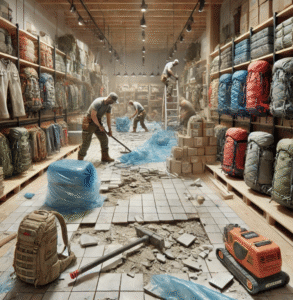
Jacksonville is built for outdoor people. Between barrier-island beach camping, river paddling along the St. Johns, and weekend escapes to Ocala or Osceola National Forest, your customers are constantly tracking in sand, mud, salt, and Florida humidity. That’s awesome for gear sales—and brutal on in-store tile flooring. If you run a camping and outdoor store in Jacksonville, you’ll eventually face the question: is it time to remove the tile?
This isn’t just a “facility” decision—it’s a sales, safety, and brand decision. Below is a practical, business-focused look at why tile removal becomes the smart move for many outdoor retailers, what it enables on the other side, and how to plan it so you protect revenue while upgrading your in-store experience. 🧩
Why flooring matters more in outdoor retail than in other shops
Your floor is the first “trail” a shopper walks when they step inside. In an outdoor store, it takes a daily beating from sandy flip-flops, wet rain jackets, muddy boots, rolling kayaks, pallet jacks, tent displays, and dog paws. The floor’s condition sets a subconscious tone: rugged-but-clean, organized-but-adventurous. When tile becomes chipped, hollow-sounding, slippery when wet, or patch-repaired, customers don’t just notice—they feel it. That feeling influences dwell time, basket size, and whether they perceive your shop as “premium” or “picked-over.”
Industry leaders are investing heavily in in-store experience because shoppers equate a fresh, functional space with trusted gear and service. From national trade shows spotlighting store-experience trends to brand and retailer expansions, the outdoor category keeps leaning into experiential retail—updated layouts, faster merchandising turns, demo zones, and purposeful materials underfoot. See examples from the outdoor industry’s flagship show and trade press: Outdoor Retailer Summer 2025 coverage and broader category news from SGB Outdoor. Outdoor RetailerSGB Online
The Jacksonville reality: tile’s weak spots in a coastal, high-humidity market
Tile looks tough, but coastal retail punishes it in specific ways. Sand acts like sandpaper on grout and glazed finishes. Saltwater and daily mopping accelerate grout discoloration and loosen edges. Frequent summer downpours mean wet vestibules and entry zones; even slip-rated ceramic can feel slick when sand, sunscreen, or seawater residue layer onto the surface. Add heavy gondolas, rack footings, and loaded pallet drops and you’ll see cracked tile corners and tent-pole “point loads” telegraphing through grout lines.
For outdoor retailers, these wear patterns cluster in high-traffic aisles (footwear, hydration, and camp-kitchen), service counters, rental or repair areas, and around cooler walls where condensation and spills happen. Once tiles start debonding, hollow-sounding “drummy” areas spread quickly. That’s not just ugly; it’s a hazard and a maintenance money pit.
Meanwhile, the broader outdoor retail sector continues to refresh footprints, open new locations, and refine merchandising—signals that stores win when they evolve the in-store environment. Look at how specialty retail continues to invest and expand, like REI’s ongoing store openings, and how trade events forecast merchandising shifts that demand more flexible floors and fixture plans (Outdoor Retailer trend previews). REIOutdoor Retailer
Six business reasons tile removal becomes the smartest move
-
Safety and risk management
Cracked tiles, popped corners, and dished grout lines become trip and slip hazards—especially in “wet gear” aisles or on big rain days. Removing failed tile lets you correct substrate flatness, install higher-traction surfaces, and maintain safer walk paths that keep customers (and staff) upright and confident. -
Faster, more flexible merchandising
Outdoor assortments change with the season—kayaks and shade canopies give way to cool-weather layers and backpacking tents. Gridded tile creates “visual friction” that makes floor moves look patchy. Removing tile smooths the canvas so you can wheel racks anywhere, add fixture anchors, and set seasonal stories without tripping on grout joints. -
Moisture and maintenance control
Jacksonville’s humidity plus sand equals constant cleaning. Grout lines harbor grime and odors; they darken in weeks and become impossible to “look clean.” Post-tile surfaces (sealed concrete, epoxy, LVT, or rubber) clean faster, need fewer chemicals, and stand up better to sandy traffic—saving labor hours you can redirect to selling. -
Brand elevation
Customers associate your floor with product trust. A refreshed, continuous surface signals “this store is modern, knowledgeable, and ready for adventure.” The outdoor industry is actively competing on the in-store experience because shoppers who come for expert advice also expect a space that feels dialed and inspiring, as seen across trade and business coverage in outlets like Outside Business Journal and SGB Outdoor. Outside OnlineSGB Online -
Back-of-house productivity
Tile in receiving and repair areas chips under pallet traffic, creates dust at failures, and jars rolling carts. Removing it and installing tougher, continuous surfaces reduces breakage, speeds turns, and keeps grit out of sensitive service benches (stoves, filters, optics). -
Futureproofing for events and community
Jacksonville customers love events—packing clinics, knot-tying demos, map-and-compass nights, and swap meets. A flatter, continuous floor better handles pop-up stages, demo boats, and education circles, turning your store into a community hub that drives loyalty and word-of-mouth.
What tile removal unlocks for your store layout and storytelling
Open sightlines and storytelling “trails”
When grout grids and patched sections disappear, your eye stops stuttering across the floor. You can define “trails” that guide shoppers from footwear to packs to camp-kitchen with purposeful endcaps and vignettes (tent + pad + lantern, cooler + camp stove + chair). The result is smoother traffic flow and higher attachment rates.
True test-and-demo areas
From trekking-pole tryouts and pack-fit stations to camp-chair sit tests and bear-can “how-to” demos, flat, durable flooring safely supports real hands-on learning. Demo-friendly store design remains a key differentiator in specialty outdoor retail—something trade coverage keeps emphasizing as brands and retailers iterate store formats and community programming (Outdoor Retailer show news; camping business updates via Outdoor Sportswire). Outdoor RetailerOutdoor Sportswire
Cleaner visual brand moments
Flooring is the “frame” for your brand photos and social content—new arrivals on a clean surface, staff picks laid out for Instagram, boot-fit before/after shots, or a ten-minute TikTok tent tutorial. Clean, continuous floors make your content pop.
Staff morale and speed
No more “tile hopscotch” with two-wheelers, fewer trip points, and easier sweeping. Small daily wins for your team add up to faster restocks and better customer engagement.
When tile removal is urgent (and when it’s just smart timing)
Urgent:
• Hollow, tenting, or shifting tiles in high-traffic lanes
• Recurring slips near entries or cooler walls
• Moisture intrusion or musty odors in grout lines
• Repeated patch jobs that won’t hold
Smart timing:
• A major category reset (e.g., expanding footwear or paddlesports)
• Adding a repair bench, rental counter, or curbside/loading station
• Launching a community calendar that needs open demo space
• Ahead of peak season (spring or fall) to capture momentum
The outdoor industry’s cadence supports refreshing stores on a rhythm—plan around line launches, seasonal resets, and local event calendars. Big retailers do this constantly as they open and modernize locations to meet shifting consumer behavior (see REI new-location updates and trade-show insights on evolving store strategies). REIOutdoor Retailer
What to put down after the tile comes up (pros/cons for outdoor retail)
Polished or sealed concrete
• Pros: Tough, continuous, easy to clean, handles sand/salt better, great for rolling loads, modern look
• Cons: Can be loud; needs anti-slip treatments and good matting at entries; temperature can feel “cool” underfoot
High-performance epoxy systems
• Pros: Seamless, slip-resistant additives, chemical-resistant, color-zoning for “trails” or service lanes
• Cons: Substrate prep is everything; plan for cure windows
Commercial-grade LVT/LVP
• Pros: Warmer acoustics, wood/stone looks without grout, easy plank replacement, forgiving underfoot for long shop shifts
• Cons: Needs quality wear layers and sand-resilient maintenance plans; watch heavy point loads from fixtures
Rubber or hybrid athletic surfaces (select zones)
• Pros: Great in rental/repair, ski/snowboard (if you sell it seasonally), or pack-fit areas; quiet and grippy
• Cons: Not ideal for the entire salesfloor unless your aesthetic supports it
Whichever route you choose, the shared goal is continuity—minimal seams, high traction, easy cleaning, and freedom to move fixtures without visible scars.
Planning tile removal with minimal downtime (and maximum upside) ⏱️
Phase the floor in “loops”
Divide your store into loops that keep a selling path open at all times. Close a loop, move fixtures into a temporary “camp,” complete demo and new floor, reset, then open the next loop. Keep your best-margin stories live.
Dust and silica controls
Use contractors who deploy HEPA air scrubbers, negative-pressure containments, and OSHA-compliant silica controls for saws and chipping. It protects staff, customers, and inventory—and keeps your daily cleaning crew from chasing gritty dust for weeks.
Protect the inventory like it’s a summit push
Shrink-wrap racks, cocoon sensitive categories (sleeping bags, apparel), and relocate optics and electronics off the salesfloor during noisy phases. Stage a temporary “trailhead” entry with extra mats and friendly signage so shoppers feel welcomed, not detoured.
Leverage the project for marketing
“Pardon our dust” can become “We’re building a better basecamp.” Tease the new layout on social. Host a “Grand Re-Trail” weekend with map-and-compass clinics, cooler giveaways, and boot-fit consults. The outdoor sector thrives when stores operate as hubs—and industry news highlights how community and retail tie together at scale across events and expansions (e.g., Outdoor Retailer news and business-side reporting like Shop Eat Surf Outdoor). Outdoor RetailerShop Eat Surf Outdoor
Coordinate with seasonal cash flow
If your summer beach-and-car-camping season stays hot into September, aim construction for late fall, or execute a two-week “shoulder-season” blitz with evening work. Ask your contractor for night or split-shift options to keep POS ringing.
Fix what’s underneath—forever
Tile removal is your once-in-a-decade chance to correct substrate cracks, moisture-vapor issues, and uneven slabs. Proper surface prep (grind, shot-blast), patching, and moisture mitigation eliminate the causes of the original failure so your new floor lives long and strong.
Budget cues and ROI (yes, floors sell gear) 📈
Think in total cost of ownership. Start with what you’re spending now in patch repairs, emergency safety cones, cleaning labor, and visual “shrink” (customers who walk out because the space feels tired). Then model the upside: faster floor moves for new lines, more demo events, higher basket sizes from better storytelling, and fewer slip-and-fall scares. Outdoor retail watchers keep noting how consumer behavior and in-store expectations are shifting; retailers who invest in smart, flexible spaces are better positioned to win the next season, not just the next weekend (see trend previews and retailer moves linked above via Outdoor Retailer, REI, SGB, and category news hubs like Outside Business Journal). Outdoor RetailerREISGB OnlineOutside Online
Bonus: Use “the upgrade story” with your customers
Let shoppers in on the why: you’re upgrading the “basecamp” so their boot-fitting is smoother, their kayak roll-outs are easier, and their clinic nights have more room. That story turns a construction project into community pride—and helps you collect emails and event RSVPs while the buzz is fresh.
Conclusion: Removing tile is a growth move, not just a maintenance fix 🌱
For a camping store, tile removal Jacksonville is really about unlocking a better customer journey: safer entries on wet days, cleaner visuals that highlight your best gear, faster seasonal resets, and more space for the demos and events that make outdoor retail special. The outdoor industry continues to evolve toward experiential, community-driven stores, and your floor is the foundation—literally and financially—of that vision. When the tile starts cracking, don’t just patch the symptom. Remove it, prep the slab right, and lay down a futureproof surface that turns your shop into the First Coast’s favorite basecamp for adventure.
Authority links (camping/outdoor store news):
• Outdoor industry show coverage: Outdoor Retailer Summer 2025 Outdoor Retailer
• Specialty retailer expansions: REI Co-op store openings REI
• Trade press for outdoor retail: SGB Outdoor SGB Online
• Business trends and retailer moves: Outside Business Journal Outside Online
• Camping category news hub: Outdoor Sportswire – Camping Outdoor Sportswire