
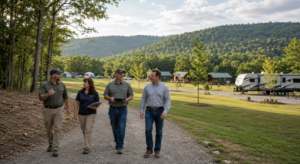
Camping in West Virginia has always been tied to the land. The mountains, thick forests, winding trails, and open spaces are a big part of what draws people outdoors in the first place. For campground owners and people developing private camping properties near Bridgeport, that natural setting is also one of the biggest responsibilities that comes with owning acreage.
A beautiful piece of land can change quickly when vegetation is left completely unmanaged. Brush pushes into access roads. Saplings crowd open areas. Weeds take over fields. Trails become harder to find, and spaces that once felt inviting begin to look neglected. None of this usually happens overnight. It happens a few feet at a time until the property owner suddenly realizes the job is much larger than ordinary mowing.
That is one reason interest in Large Acreage Vegetation Management Bridgeport WV is growing among property owners with camping land, recreational acreage, and outdoor destinations. The goal is not to strip a property of everything natural. Good vegetation management is about controlling problem growth while keeping the outdoor character that makes West Virginia camping special. 🌲🏕️
Camping Is a Natural Fit for West Virginia’s Landscape
West Virginia and camping simply belong together. The state’s mountain terrain and wooded landscape have helped create an outdoor culture built around hiking, fishing, campfires, RV travel, and weekends spent away from crowded cities.
The official West Virginia Tourism camping guide highlights camping and RV destinations throughout the Mountain State. At the same time, West Virginia State Parks continues to promote camping alongside hiking, fishing, boating, biking, and other outdoor activities. Those resources show just how closely camping is connected to the state’s broader recreation economy.
Bridgeport’s central location also gives visitors access to parks, trails, and outdoor attractions around north-central West Virginia. The Bridgeport Convention and Visitors Bureau points visitors toward nearby hiking trails, fitness trails, lakes, and parks. For camping property owners, that regional interest in outdoor recreation creates an opportunity to build places where travelers can stay, relax, and use as a base for exploring the area.
The challenge is keeping larger properties usable without making them feel overdeveloped.
A camper does not necessarily want a perfectly manicured commercial lawn stretching from one side of a property to the other. Most people go camping because they want trees, wildlife, quiet, and a more natural atmosphere. At the same time, guests still expect to be able to reach their campsite, walk a trail, park a vehicle, and enjoy common areas without fighting through chest-high weeds and tangled brush.
That balance is where vegetation management becomes important.
Large Camping Properties Can Become Overgrown Faster Than Owners Expect
Anyone who has managed several acres knows there is a major difference between maintaining a yard and maintaining camping property.
A lawn mower may be fine around an office, bathhouse, cabin, or small group of campsites. Once the land stretches into large fields, wooded edges, steep ground, and miles of property lines, traditional lawn maintenance is often no longer practical.
West Virginia’s terrain adds another layer to the job. The state is known for its mountainous Appalachian geography, a characteristic described in the overview of West Virginia on Wikipedia. Uneven land, slopes, wooded sections, and naturally rugged terrain are part of the state’s appeal, but those same features can complicate property maintenance.
Brush can fill an unused field surprisingly fast. Trees and woody growth may begin moving into open areas. Vegetation along gravel roads can reduce visibility. A trail that was easy to follow one season may feel completely different after a long period without maintenance.
For a private landowner, that may simply be frustrating. For someone operating or developing camping property, it can affect the experience guests have from the moment they arrive.
🏕️ A narrow entrance can make an RV driver uncomfortable.
🌿 Overgrown campsite edges can make a space appear smaller.
🚙 Vegetation around internal roads may create visibility problems.
🥾 Unmaintained trails can discourage guests from exploring the property.
🔥 Excessive unmanaged plant material can also create maintenance concerns around heavily used areas.
The property may still be beautiful underneath all that growth. The problem is that guests can have a difficult time seeing its potential.
Campers Notice the Condition of a Property Immediately
Camping is rustic, but rustic and neglected are not the same thing.
Experienced campers understand dirt roads, trees, insects, uneven ground, and changing weather. Those things are part of being outside. What people tend to notice is whether the property appears cared for.
A maintained campground entrance sends a different message than an entrance hidden behind uncontrolled vegetation. Clearly defined camping areas feel more intentional. Open paths invite guests to take a walk. Managed edges around common spaces can help a large property feel organized without destroying its natural appearance.
This matters even more now that campers frequently research destinations online before visiting. Photographs of a property may be viewed long before someone sees the campground in person. Wide outdoor views, visible roads, clean camping areas, and attractive natural boundaries can photograph much better than acreage swallowed by uncontrolled growth.
West Virginia’s public camping destinations provide a useful example of how access and the natural environment work together. The National Park Service camping information for New River Gorge National Park and Preserve describes primitive camping areas with limited facilities. Even in these intentionally primitive settings, camping takes place in established areas rather than treating every section of land as an uncontrolled campsite.
Private camping property owners can take a similar lesson from that approach. A property can remain natural while still having a plan.
Vegetation Management Can Help Create Better Campsite Layouts
One of the most interesting reasons camping property owners are paying attention to vegetation management is the ability to see their land differently.
Heavy brush can hide usable ground.
An area that appears worthless from a distance may contain relatively open terrain underneath several seasons of unwanted growth. A property owner may discover opportunities for additional tent sites, future RV areas, walking paths, picnic locations, or scenic gathering spaces after problem vegetation is brought under control.
This does not mean every open acre should become another campsite. In fact, overcrowding a camping property can damage the atmosphere that visitors came to enjoy.
Strategic clearing and vegetation control give an owner more choices.
A few secluded tent sites may fit naturally along one section of the property. A wider open area may work better for RV access. Existing trees may provide shade around another location. A field edge might become part of a walking trail rather than a camping site.
When the land is visible and accessible, planning becomes easier.
This idea can be seen throughout West Virginia’s outdoor recreation network. The West Virginia Division of Natural Resources promotes state parks and forests for camping and a broad variety of mountain adventures. These outdoor spaces are valued for their natural character, yet recreation still depends on designated places and maintained access.
Camping property owners do not need to imitate a state park. The basic principle still applies. People enjoy natural land more when they can safely and comfortably use it.
Access Roads and Trails Need Room to Breathe
A camping property can have incredible views and beautiful sites, but guests still need to reach them.
Internal access is especially important when RVs, trailers, trucks, and camping equipment are involved. A road that feels wide in winter can seem dramatically narrower after vegetation fills out during the growing season.
Branches, brush, and tall growth along road edges can create a closed-in feeling. Drivers may become nervous about scratching their vehicles. Two-way traffic can become more difficult. Curves and intersections may be harder to see around.
Regular vegetation management can help preserve the original width and visibility of these routes.
Trails have similar needs.
West Virginia campers often combine an overnight stay with hiking and outdoor exploration. The Monongahela National Forest camping and cabins information reflects the strong relationship between camping and other outdoor recreation in the state’s forested areas. The national forest itself spans nearly one million acres across ten West Virginia counties, according to the U.S. Forest Service.
A private camping property does not need hundreds of miles of hiking opportunities to create a memorable experience. Sometimes a simple loop through the woods or a short trail to an overlook can become one of the most popular features on the land.
Those trails still need to remain visible.
When vegetation takes over, guests may stop using them. A trail that no one uses can disappear even faster. Managing growth around these areas helps keep outdoor features part of the property instead of allowing them to fade back into inaccessible acreage.
The Goal Is Not to Remove Everything Green
There is a major misconception that vegetation management means turning wooded acreage into a giant empty field.
For camping property, that would often defeat the entire purpose.
Trees provide shade. Natural boundaries create privacy between campers. Forested areas add visual interest. Native vegetation contributes to the feeling of being in the mountains rather than sitting in an oversized parking area.
The goal should be control and purpose.
Property owners can identify the areas that need to remain open and the areas that should remain more natural. Roads, campsites, parking locations, building surroundings, trail corridors, and certain gathering spaces may need more active attention. Other sections may only need selective management to prevent unwanted growth from spreading.
This type of thinking is particularly relevant in a state where forest recreation is such a major part of the outdoor identity. Even the Wikipedia overview of Monongahela National Forest lists camping alongside hiking, mountain biking, horseback riding, fishing, and wildlife viewing as common recreational uses of the forest.
The outdoor experience depends on nature.
Vegetation management should help people experience the land, not erase the reason they came.
Property Maintenance Can Support Long-Term Camping Plans
Some camping properties around Bridgeport are already operating businesses. Others may still be ideas in the mind of a landowner.
A person may own twenty, fifty, or several hundred acres and wonder whether part of the land could eventually be used for primitive camping. Another owner may want to add a few rental cabins. Someone else may be considering RV spaces or a private family camping retreat.
In each of those situations, understanding the land is one of the first steps.
It is difficult to plan around acreage that cannot be easily accessed or viewed. Heavy vegetation can hide drainage patterns, old roads, open ground, property features, and natural routes through the land.
Managing selected areas can make it easier to evaluate what the property already offers.
There may be an old path that could become a trail. A forgotten opening may offer a surprisingly good view. A section close to an existing road may be a practical future camping area. Another location may clearly be better left untouched.
Land decisions become more informed when owners can actually see and move through the property.
🌄 That is particularly valuable in the camping business because the best feature on a piece of acreage is not always a building. Sometimes it is a view, a group of mature trees, an open meadow, or a quiet corner that guests remember long after they leave.
A Better Camping Experience Starts With Thoughtful Land Care
West Virginia continues to celebrate camping as part of its outdoor identity. From state parks and private campgrounds to primitive national park sites and forest recreation areas, visitors have many ways to spend a night outdoors.
For private camping property owners near Bridgeport, this creates both an opportunity and a responsibility.
The opportunity is to offer people an authentic West Virginia outdoor experience. The responsibility is maintaining enough control over the land so guests can actually enjoy it.
Vegetation management is becoming part of that conversation because owners are recognizing that unmanaged acreage rarely stays the same. Roads become narrower. Fields become thicker. Trails disappear. Brush moves into usable areas.
Taking care of those issues earlier can help protect the layout and character of the property.
Conclusion
Camping property owners do not have to choose between wild West Virginia scenery and usable land. The two can work together beautifully when acreage is maintained with a clear purpose.
Thoughtful vegetation management can preserve access roads, define camping areas, reopen trails, improve the appearance of common spaces, and help owners identify opportunities hidden beneath years of unwanted growth. Most importantly, it can do all of that while allowing the trees, mountains, and natural atmosphere to remain at the center of the camping experience. 🌲🔥🏕️
For camping property owners in and around Bridgeport, managing large acreage is becoming less about simply cutting weeds and more about protecting the long-term potential of the land. A well-cared-for property gives campers room to explore, gives owners more options for the future, and allows the natural beauty of West Virginia to remain the feature everyone remembers.
Related posts:
- Things You Need When Camping With Children
- How IRS Attorneys Who Hate Camping Can Learn to Enjoy It: A Step-by-Step Guide
- How a Kirkwood, MO Camping and Outdoor Store Can Benefit from Hiring a Kitchen Remodeling Company
- Why a Los Angeles Camping Store Needs Owner’s Representation During Construction Projects 🏕️🔨